


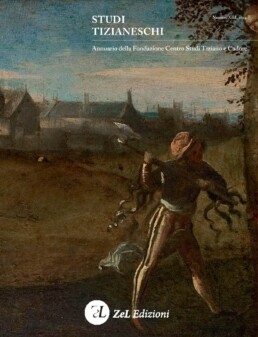
Studi Tizianeschi XIII
Year 2024
Pages 150
Price: 25.00 €
Online price: 23.00 €
Free delivery in Italy, payment on delivery abroad
The thirteenth issue of “Studi Tizianeschi,” “Titian Studies,” opens with three essays which, in the diversity of their topics, reflect the hope expressed in the annual’s title, indicative of a wide range of research and disciplinary breadth.
Nicole de Manincor, winner of the recent Gemma Donata Nicolosi Prize, with her “New Insights and Considerations on the two Emo Capodilista Panels by Titian in Padua, “offers a convincing hypothesis regarding the original use of The Myth of Adonis and The Myth of Erysichth, the Cadorian artist’s debut panels, preserved at the Musei Civici agli Eremitani in Padua, either as a frieze in a room or, perhaps, a study, rather than as frontal panels of chests, as generally assumed. Based on coherent key interpretative arguments and the results of recent diagnostic analyses, the text ends with the suggestion of an unpublished third panel of similar dimensions attributed to the Titianesque circle.
In addition, a “precocious, constant, and progressive genius, ”Antonio Morassi’s Titian” by Camilla Traldi, presents a selection of material from the great art historian’s archive, preserved at Ca’ Foscari University in Venice, a valuable aid to reconstructing the intellectual relationship between Morassi and Titian, the subject of study which seems to have absorbed him from his formative years to the end of his life.
Letizia Lonzi and Antonio Genova return us to the patrons of the altars of the Vecellio family in the ancient Archidiaconal Church of Pieve di Cadore, beginning with Graziano and the noble chapel that houses Titian’s recently restored votive painting, expanding their investigations through careful study of documents and genealogical trees, to the branch of the Vecellio di Pieve family nicknamed Zamberlan, with some digressions to include the painters Antonio Rosso and Zaccaria da Pieve.
If Number XII was focused on the conference events of “Titian and his. A project, a perspective (Belluno, 2022),” place is given here to those of the study day, “The Birthplace of Titian: yesterday, today and tomorrow,” organised by the Magnifica Communita di Cadore and held in Pieve di Cadore on December 17, 2022, on the centenary of the declaration of the building as a National Monument.
Additionally, published here is the contribution of Letizia Lonzi and Antonio Genova on the history of Titian’s family home, which escaped the devastations and reprisals of the Cambrian wars and subsequent conflicts. It is a typical house of a lineaged local family. There is also the study on the restoration works carried out in the early decades of the twentieth century with detailed documentary and iconographic research from the archives of the Superintendence, edited by Viviana Ferrario, Angela Squassina, Mauro Marzo, Nicola Badan, and Davide Zanon from the IUAV of Venice.
Completing this issue are reviews of two publications on Bosch and Charles Hope’s essential volumes on Titian sources and documents, as well as reviews of exhibitions dedicated to Carpaccio (Washington, National Gallery of Art / Venice, Palazzo Ducale), Titian (Venice, Gallerie dell’Accademia), Paris Bordon (Treviso, Museo Santa Caterina), El Greco (Milan, Palazzo Reale). In conclusion, it is evident from analysis of the exhibition on Rubens at the Galleria Borghese in Rome, that the Flemish artist’s mind was “still and always” focussed on Titian.
At the time of going to press, with the sad news of the death of Antonio Paolucci, an extraordinary figure in art history, a superintendent, and a minister, it seemed fitting and proper to pay him a heartfelt tribute.
INDEX:
7
Premessa
Stefania Mason
8
Notizie dal centro studi
Maria Giovanna Coletti, Stefania Mason
11
Nuove luci e considerazioni sulle due tavole
Emo Capodilista di Tiziano a Padova
Nicole de Manincor
31
Gli altari dei Vecellio nell’antica Arcidiaconale di Pieve di Cadore.
I (Vecellio) Zamberlan e i pittori Antonio Rosso e Zaccaria
Letizia Lonzi, Antonio Genova
53
Un «genio precoce, costante e progressivo»: il Tiziano di Antonio Morassi
Camilla Traldi
70
Editoriale
Letizia Lonzi
73
Vicende della casa Vecellio attraverso fonti e personaggi.
Tra ampliamenti, riduzioni, residenti illustri, affittuari popolari e viaggiatori curiosi
Letizia Lonzi, Antonio Genova
101
Il restauro novecentesco della casa di Tiziano a Pieve di Cadore:
analisi documentale e letture dirette
Angela Squassina, Viviana Ferrario, Mauro Marzo, Nicola Badan, Davide Zanon
118
Recensioni – libri
Charles Hope
Titian. Sources and Documents
Bernard Aikema
122
Recensioni – libri – mostre
Bosch e l’altro Rinascimento,
a cura di Bernard Aikema e Fernando Checa Cremades
Giorgio Tagliaferro
127
Recensioni – mostre
Vittore Carpaccio. Master Storyteller of Renaissance Venice
James R. Jewitt
131
Tiziano 1508. Agli esordi di una luminosa carriera
Christophe Brouard
136
Paris Bordon 1500-1571. Pittore divino
Benjamin Couilleaux
138
El Greco. Un pittore nel labirinto
Enrico Maria Dal Pozzolo
140
Il tocco di Pigmaglione. Rubens e la scultura a Roma
Claudio Strinati
143
Premio Gemma Donata Nicolosi Dal Pozzolo 2024
144
Antonio Paolucci (1939-2024), ricordo di un soprintendente-ministro
Luca Brignoli
149
Gli autori
150
Referenze fotografiche